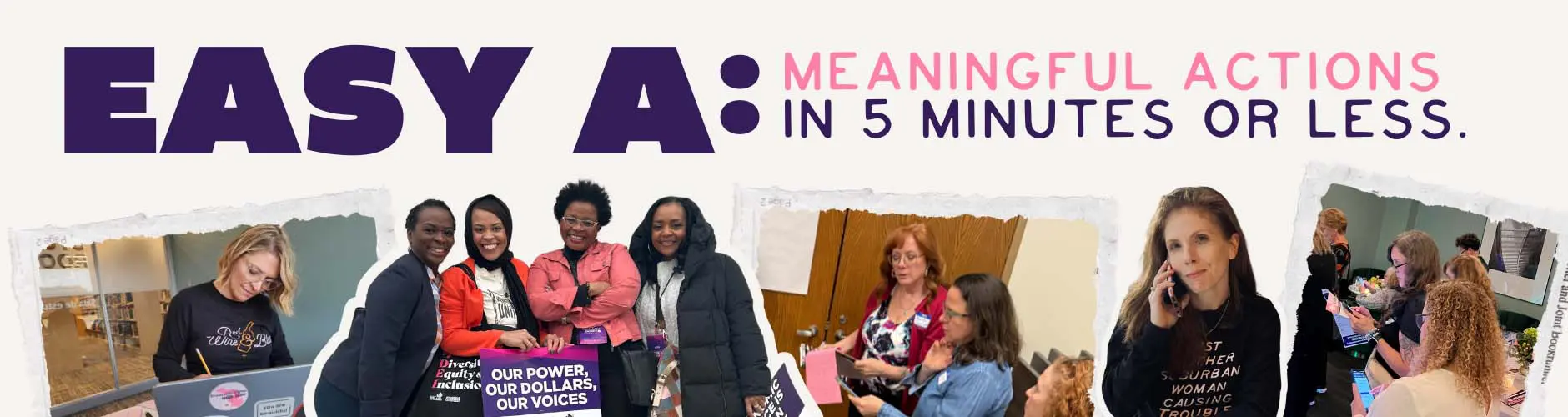
Hi there! Welcome to Easy A–Your go-to source for quick and easy actions you can take in five minutes or less about the issues you care about.
Are you a busy mom? Or maybe your work is so hectic you can’t think about anything else during the day? A lot of us are also taking care of parents or other loved ones too, leaving little time for anything else.
The good news is that these are things you can do while you’re waiting in the school pick up line, on your lunch break, or even at your kid’s soccer practice – anywhere you happen to be! And you can easily share Easy A with your friends so they can be in the know, too! We’ll send you a new action to take every week–just one, we promise –and it will always be something you can do in five minutes or less. Ready to get started? Let’s go!
Do This: Find the Women Making History Near You
Red Wine & Blue’s theme song is “We Came To Make A Change” and we aren’t kidding! Our members are making history every day in their communities through changemaking actions, big and small.
From holding a “Save Sesame Street” bake sale supporting a North Carolina PBS station to a local art show fundraiser supporting reproductive rights organizations in California – both raised thousands of dollars!
And from filling food and diaper banks to organizing lobby days at state legislatures –our members are supporting their neighbors’ immediate needs AND demanding their elected representatives address those needs through lasting legislation.
You can be a part of these changemaking efforts, too.
No matter how much (or how little) time you have to spare, local groups in the Red Wine & Blue Network are looking for new members with a full range of time, talents, and skills right now.
Let’s close out Women’s History Month with a commitment to writing the next chapter. Take a few minutes to search our map and join the women making history near you today!
Watch This: Celebrating Women’s History Month
America has been celebrating March as Women’s History Month since 1987, but we know that women have been making history since the very beginning.
Take a few minutes this week to watch our recap of notable moments in the history of women’s rights:
As we celebrate this progress, we also recognize there’s still a lot of work to do! The good news is, women are great organizers and Red Wine & Blue members are leading the way. Come back next week for an easy way to join us in making our own history.
Read This: Notable Moments in the History of Women’s Rights
March is Women’s History Month, which evolved from women fighting for better working conditions, women’s suffrage, and equality in education. Those are our people!
Thanks to lobbying by the National Women’s History Alliance, President Jimmy Carter proclaimed the first National Women’s History Week in 1980. In 1987, Congress passed a law to designate it as a month-long recognition.
Let’s take a few minutes to reflect on some notable moments in women’s history, specifically progress that’s been made in women’s rights:
- 1920. The 19th Amendment is ratified, giving women the right to vote nationwide (although we know now that discrimination will keep non-white women from voting for decades to follow).
- 1960.The birth control pill is approved by the FDA.
- 1963. The Equal Pay Act requires equitable wages for men and women.
- 1965. The Voting Rights Act prohibits race-based discrimination, removing the barriers to voting that non-white women still face despite the 19th Amendment.
- 1965. The U.S. Supreme Court establishes a constitutional right to privacy, allowing married couples the right to use contraceptives.
- 1969. California passes the first “no fault” divorce law, making it easier for women to get divorced. This eventually spreads to all 50 states.
- 1972. Title IX prohibits sex-based discrimination in school programs and activities that receive federal funding.
- 1972. Congress passes the Equal Rights Amendment to constitutionally guarantee equal rights regardless of sex or gender, though it struggles to be ratified by enough states by its Congressionally-required deadline.
- 1972. The U.S. Supreme Court rules that the constitutional right to privacy extends to unmarried people’s right to use contraceptives.
- 1973. Roe v. Wade makes abortion legal.
- 1974. Congress adds sex as a protected class in civil rights law.
- 1974. The Equal Credit Opportunity Act makes it legal for women to open bank accounts and apply for credit cards, car loans, and home loans without a male co-signer.
- 1981. The U.S. Supreme Court overturns state laws that give a husband sole control over property that is jointly owned with a wife.
- 1993. The Family and Medical Leave Act gives women job protection – albeit unpaid and limited to 12 weeks – if they need to take leave for family reasons, like maternity leave.
- 2022. The U.S. Supreme Court overturns Roe v. Wade with the Dobbs v. Jackson Women’s Health decision, removing women’s constitutionally protected right to abortion.
After nearly 250 years of slow, hard-won progress in women’s rights, it’s worth noting that the Dobbs decision in 2022 is the first time that the U.S. Supreme Court took a constitutional right away from citizens, rather than granted or expanded one.
We know from history that women will not stand for this reversal of progress, and we’re here to support those who are fighting back and making history of their own today.
Sources:
- Women’s History Milestones: Timeline, History.com
- The Equal Rights Amendment, Explained, Brennan Center for Justice
- Timeline of Legal History of Women in the United States, National Women’s History Alliance
- Women’s rights throughout U.S. history, Politico
Do This: Test Your Knowledge of Black History
Pop quiz! Let’s test what you’ve learned from our Black History Month Easy A actions over the past two weeks!
Want to challenge your friends and family to test their knowledge, too? Use the post below to share on your favorite social media or messaging apps.
Watch This: Black History You May Not Have Learned in School
Have you ever heard of America’s Black Belt? No, we don’t mean martial arts!
The Black Belt is a geopolitical region across the South. Its name originally referred to land where the soil was fertile and agriculture was strong, which meant it also had a high population of enslaved people. Now it refers to a Southern swath of counties where Black residents are the majority of the population.
Learn more by watching this one-minute video about the Black Belt:
These areas once thrived under Black leaders who represented their communities, but many of them lost their positions of power once white supremacists started disenfranchising Black voters after Reconstruction.
This rise in voter suppression in the South went hand-in-hand with an intentional whitewashing of the history taught in public schools – an effort led by the United Daughters of the Confederacy.
This erasure of Black History is one reason a lot of us never learned about the Black Belt. But we can change that by sharing the stories of these vibrant communities, as well as the history they are still making today, like Plymouth, North Carolina just electing their first Black female mayor, Crystal Davis, in 2025! And come back next week for another easy action to celebrate Black History Month.
Read This: More Hidden Figures in Black History
You may be familiar with the movie, “Hidden Figures,” based on Margot Lee Shetterly’s book of the same name. It told the true story of Black women mathematicians for NASA who were critical to the success of the U.S. space program, but who had been overlooked by history books.
Shetterly brought the names of Christine Darden, Barbara Holley, Mary Jackson, Katherine Johnson, Kathryn Peddrew, Eunice Smith, Sue Wilder, and Dorothy Vaughan to popular culture, teaching many of us Black history that we never learned in school. But countless other figures have been hidden or overshadowed in history, so let’s shine a light on a few more!
Dr. Gladys West
Dr. Gladys West was also a mathematician. She was one of only four Black professionals working at the Naval Surface Warfare Center Dahlgren Division in Virginia when she was hired in 1956. Dr. West conducted research on satellite orbits and modeling the surface of the Earth. The mathematical model she created paved the way for Global Positioning System (GPS) technology.
While her career with the U.S. Navy spanned 42 years and her contributions to the creation of GPS are widely agreed upon, Dr. West didn’t receive public recognition until after “Hidden Figures” was released in 2016. In 2018, the military honored her as a Space Pioneer, and the Virginia General Assembly passed a joint resolution commending her work. In 2021 she was the first woman to receive the Prince Philip Medal from Britain’s Royal Academy of Engineering. In 2023 she was honored by the U.S. Navy with the first Freedom of the Seas Exploration and Innovation Award.
Dr. West died on January 17, 2026 at 95 years old. You can think of her with gratitude the next time you plug an address into your GPS!
Claudette Colvin
In January, we also lost an often overshadowed figure of the civil rights movement. Claudette Colvin passed away at the age of 86. While most of us learned in school about Rosa Parks’ bravery, Claudette Colvin was arrested for displaying the same bravery in March 1955, nine months before Rosa Parks.
Fifteen year-old Claudette was riding home from school on a segregated bus in Montgomery, AL. While she was seated in the back of the bus, it filled and the driver ordered Black passengers to give up their seats for white riders. Claudette refused and was arrested. Months later in October, Mary Louise Smith was arrested for the same thing, followed by Rosa Parks in December. Rosa Parks’ arrest sparked the Montgomery Bus Boycott, so her name earned a rightful place in history, but Colvin and Smith were two of the four plaintiffs in the landmark case that ended racial segregation on Montgomery’s buses.
Colvin laid the groundwork for progress when she refused to give up her seat in 1955, and again in 2021 when she filed to have her record expunged, having never technically been cleared of her charges. She said it was important to show the next generation that “…progress is possible, and things do get better. It will inspire them to make the world better.”
The Bennett Belles
Many of us learned about strategic nonviolence and sit-ins as methods of protest during the Civil Rights Movement. While it was not the first, the sit-in led by the Greensboro Four at the Woolworth’s lunch counter in Greensboro, NC on February 1, 1960 gained national attention and is credited with launching a nationwide movement.
The Greensboro Four were male students from North Carolina Agricultural and Technical State University – Ezell Blair, Jr. (now Jibreel Khazan), Franklin McCain, Joseph McNeil and David Richmond, but have you ever learned about the women behind the movement? Female students like Linda Brown and Emma Washington from Bennett College played a huge role. In fact, hundreds of students known as the Bennett Belles helped plan and execute the Greensboro sit-ins.
These female students had been organizing since Martin Luther King, Jr. spoke at Bennett College in 1958. In the fall of 1959, NC A&T students joined NAACP student chapter meetings at Bennett College where the sit-ins were planned. 40% of Bennett College students participated in demonstrations between 1960 and 1963, and 250 of them were arrested during the months of the lunch counter sit-ins.
Perhaps the ultimate Bennett Belle was the college’s President, Dr. Willa Beatrice Player who first brought King to campus and who supported her students throughout the entire movement. She even brought them personal items and school assignments while they were in jail! The sit-ins eventually lead to the desegregation of the lunch counters in July 1960, and we have the Bennett Belles to thank for that!
During Black History Month, and all year long, it’s important to keep uncovering these hidden, unsung, and overshadowed heroes of the past so that we can all learn the full story of American history.
Do This: Share These News Literacy Tips
National News Literacy Week may be over, but we have one more action to take to make it a success!
An important part of News Literacy Week is sharing its tips and resources with others. Earn your Easy A this week by sharing our 5 Steps to Evaluate News Sources video with friends and family, especially any kids or teens in your life.
Share one (or both!) of the premade posts below using your favorite social media or messaging apps. They are ready to share and include a link to the video we watched last week.
Together, we can help spread the word about media literacy and help fight misinformation, one source at a time!
Watch This: 5 Easy Ways to Check a News Source
It’s National News Literacy Week!
Led by the News Literacy Project, this week highlights the need to restore trust in news journalism, improve media literacy, and keep us all grounded in facts.
News Literacy Week’s website provides tools and resources for parents, teachers, and other concerned adults in order to help kids and teens – and ourselves – navigate today’s media environment, and we’re joining in.
Earn your Easy A this week by watching this short video with 5 Easy Ways to Check a News Source:
Understanding and modeling news literacy like this for our kids and teens is important. Next week, we’ll take one more action as part of National News Literacy Week – see you then!
Read This: Get Ready For National News Literacy Week
The First Amendment of the U.S. Constitution says: “Congress shall make no law … abridging the freedom of speech, or of the press.” Having independent journalists reporting facts and holding people and institutions accountable is a hallmark of our democracy. That’s why next week, we’re celebrating National News Literacy Week.
What is National News Literacy Week?
National News Literacy Week is organized by our friends at the News Literacy Project, The E.W. Scripps Company (that’s right, the folks who do the National Spelling Bee!), USA Today, and the USA Today Network. It’s a week for teachers, families, and other caring adults to help kids and teens learn how to navigate today’s news and media environment. (And let’s be honest, a lot of adults need to learn these skills too!)
This year’s News Literacy Week is focusing on staying grounded with facts and on rebuilding trust in credible news sources. This is important as we all navigate media ecosystems where algorithms determine what we see, and where artificial intelligence (AI) is flooding the zone with fake photos and videos that are looking more and more real every day.
In a recent survey, the News Literacy Project found that U.S. teens are increasingly distrusting of the information they consume. Their suspicion may come in handy, given that separate research found that 15 out of 20 videos on Instagram Reels are AI slop! (“Slop” is a term used for low-quality content that is usually generated just to feed social media algorithms, keep people scrolling, and generate advertising income.)
No wonder that the News Literacy Project also found that 84% of U.S. teens have negative views of the news media and journalists. This isn’t surprising since we live in a time when politicians frequently label anything they don’t like as “fake news” or “alternative facts,” but if a healthy democracy needs a free and functioning press, it also needs its people to trust them!
What is news literacy?
News literacy is:
- Understanding why the freedom of press is an important part of our Constitution.
- Learning the values of professional, ethical, and credible journalism: commitment to accuracy, fairness, independence, and accountability.
- Recognizing our own biases as well as biases we see in reporting.
- Putting all these skills together in order to assess news sources for accuracy and reliability.
- Using the trustworthy sources we identify to inform our civic decisions like voting.
The News Literacy Project provides resources for teachers to use in classrooms and for parents, grandparents, aunts and uncles, and other mentors to use at home and at work – or to just learn for ourselves!
In our rapidly changing information environment, we need to be able to separate fact from fiction and truth from lies. Now that we can all freely share news and information with each other, bad information can go viral quickly, causing lasting damage.
Our kids and teens are smart to have a healthy level of skepticism, but let’s make sure they also know which news sources to trust so that our free press can continue to provide truth and accountability to serve us all for the greater good.
News Literacy Week kicks off on Monday, February 2. In next Thursday’s Easy A, we’ll learn how to assess news sources for credibility.
Do This: Name your 2026 Priority
The Heritage Foundation is the extremist architect of Project 2025, and they’ve made their priorities known for 2026. They’ve given us a glimpse at what harmful policies they want the Trump administration to enact this year, so now it’s time to set your priorities, too.
Your easy action is simple – and highly personal – this week: identify which issue concerns and moves you to action the most.
Here’s some tips on how to do that:
- Take a minute to reflect on what you read about Project 2026 two weeks ago.
- Give our Project 2025 Tracker a quick scroll.
- Pay attention to what made your heart sink or felt like a gut punch – what gave you the strongest reaction when you learned about it, like we discussed on the RWB podcast recently?
Identify the most important area for you to personally make a difference this year, and then let us know below. We’ll be sure to let you know when there are future easy actions to take in your area of interest.
Watch This: What You Can Do About Project 2026
About half of the Heritage Foundation’s Project 2025 has been implemented. It can be easy to feel overwhelmed when you see all the ways it’s harming Americans, especially when you see it all in one place (which you can do in our Project 2025 Tracker).
And now that they’ve told us what their priorities are for 2026, a lot of us are wondering, how do we stop them from accomplishing it all?
We explored this question on last week’s episode of the Red Wine & Blue podcast: How to Not Lose Your Sh!t. Take a minute to watch this short clip from that conversation.
So, don’t lose your sh!t – we’ve got this! We’ll keep bringing you the information you need and the easy actions you can take to make a difference wherever you are most called.