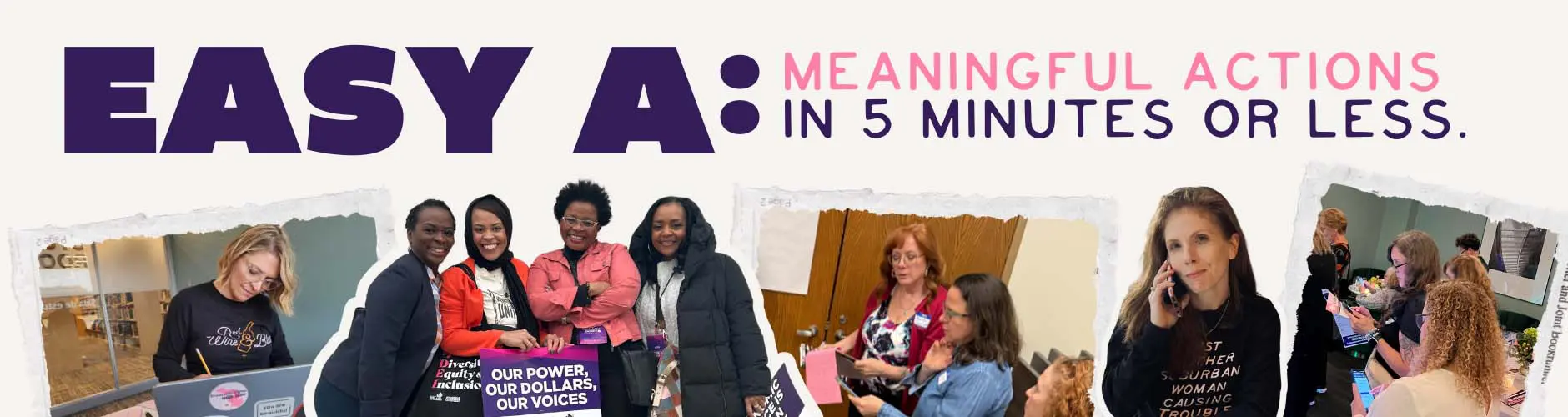
Hi there! Welcome to Easy A–Your go-to source for quick and easy actions you can take in five minutes or less about the issues you care about.
Are you a busy mom? Or maybe your work is so hectic you can’t think about anything else during the day? A lot of us are also taking care of parents or other loved ones too, leaving little time for anything else.
The good news is that these are things you can do while you’re waiting in the school pick up line, on your lunch break, or even at your kid’s soccer practice – anywhere you happen to be! And you can easily share Easy A with your friends so they can be in the know, too! We’ll send you a new action to take every week–just one, we promise –and it will always be something you can do in five minutes or less. Ready to get started? Let’s go!
Watch This: Heather Cox Richardson’s Midterm Election Advice
Midterm Election Day is just around the corner on November 3, but early voting has already started, or is starting in many states soon. In other words, the election is now!
We know it’s important to vote in the midterms, but we also know that many of our friends and neighbors don’t do it. So, it’s not enough that we ourselves just show up and vote, we also need to encourage everyone we know to join us. That’s why Red Wine & Blue does friend-to-friend organizing, the most effective way to turn out voters every election.
Earn your Easy A this week by watching everyone’s favorite historian, Heather Cox Richardson, explain why friend-to-friend organizing is the most important and effective thing you can do right now to influence midterm election results.
We can’t assume that everyone we know is registered, has a plan, and is ready to show up to vote in the midterms. Even some of Heather’s friends weren’t! We’ll continue to take easy actions between now and Election Day to make sure we’re all ready to vote!
Read This: Five reasons to vote in the midterm elections
We are just 26 days away from midterm Election Day, so let’s spend the next few weeks getting ourselves and everyone we know ready to vote.
Voters usually turnout more in Presidential elections than they do in midterm elections. For example, 66% of voters cast a ballot in 2020’s Presidential election and 64% in 2024, but only 46% voted in the 2022 midterms!
That’s a problem because midterm elections decide local and statewide leaders, including the people who make decisions about our schools and state laws, as well as the direction our cities and counties will take. Midterms also decide who represents us in Congress. All of these positions impact our daily lives just as much as the President does, often even more.
Here are five reasons why voting in midterm elections, especially local races, is important:
- Turning out voters for local races in the midterms automatically helps the more visible national races. Bottom line, we need more people voting for every race. If people are excited about voting for local races because they care about the issues that are hitting close to home, they are far more likely to also vote for the bigger races at the top of the ballot. It doesn’t always work the other way around. The more voices heard for every seat, the better.
- The people we put in power during the midterms help check executive power. Local power is our greatest leverage against decisions we don’t like at the national level. School boards make decisions about our kids’ and grandkids’ schools. City, town, and county leaders decide what happens with data centers, surveillance cameras, and detention centers in our communities. State legislatures set public school funding and access to health care. The people we elect in the midterms provide important checks and balances on the executive branch elected during Presidential elections.
- Voting for local races in the midterms keeps us civically engaged, even if national-level politics has turned us off. Millions of people are overwhelmed, exhausted, and turned off by capital-P Politics right now. We get it! But we all still care about what’s happening in our schools and neighborhoods, because that’s personal. Voting for midterm races keeps us connected and makes sure our voices are heard.
- Voting for local races in the midterms helps people focus on issues and candidates, not political parties. Voters, especially suburban women, are disillusioned by party politics and are avoiding or abandoning party affiliations altogether. We want to focus on our values and improving our communities. Focusing on local races, some of which are nonpartisan, helps us do that.
- Keeping voters engaged during midterm elections builds opportunities to stay involved year-round. Our democracy works best when citizens are actively involved in the process and in local government. Voting in every single election keeps us in the know. It’s also the most powerful way to be heard and to hold our elected representatives accountable.
We should be voting in every single election, and Red Wine & Blue knows the most impactful way to get voters involved – and have fun while doing it! Over the next few weeks, we’ll take more easy actions to get everyone we know ready to vote in the November 3 midterms.
Do This: Participate in Banned Books Week
Unite Against Book Bans, an initiative of the American Library Association (ALA), hosts Banned Books Week every year. This year’s Banned Books Week starts in just a few days and runs from October 4 to 10.
More than 4,200 books were challenged in 2025, and we need to stand up for the right to read. There are a lot of things we can do to fight book bans. Every action we take, no matter how big or small, makes a difference. One of the easiest things we can do is share information!
We need to drown out the noise from the book banners and spread the truth. The ALA has a lot of information and resources on banned and challenged books, and we’re making it super easy for you to share it with your networks.
Take part in Banned Books Week and earn your Easy A by sharing the post below using your favorite social media and messaging apps.
And if you have time to do more, now or in the future, here are some more suggestions for taking action against book bans from Betsy Gomez of the ALA:
- Report censorship to the ALA if and when you see it. Anyone can submit reports to their database.
- Have conversations with friends and family about what’s going on with book bans in our schools and public libraries. The ALA has tips for how to effectively have these conversations.
- Don’t forget to talk with your local librarians, too! Ask them what they need and how you can support them.
- Tell decision makers that you support the freedom to read. Whether it’s school boards, library boards, state legislators, or elected representatives at the national level — if book bans or laws relating to censorship are on the table, make your voice heard through public comments, phone calls, messages, and petitions.
- Volunteer at your local library. Join local boards, book review committees, or a local “Friends of the Library” group.
- Join Red Wine & Blue’s Book Ban Busters.
- Watch our full event with Betsy here to learn more.
Together, we can unite against book bans and protect our freedom to read.
Watch This: How book banners are threatening librarians
If you were asked to list dangerous jobs in America, you might think of firefighters, power line workers, or maybe people in construction. But librarians?
In a recent survey, U.S. library workers reported more than 8,200 traumatic incidents in their jobs, ranging from harassment and threats to verbal abuse and physical assault. Betsy Gomez of the American Library Association (ALA) talked about some of those incidents during a virtual Red Wine & Blue event last month.
Earn your Easy A this week by watching this one-minute video from that event. It might surprise you to hear all the ways our librarians have to worry about their personal safety and security.
Public librarians should be planning children’s story hours, adult literacy workshops, and teen book clubs, but the latest trend in book banning has them making emergency safety plans instead. So next week, to help kick off ALA’s Banned Books Week, we’ll take another easy action in support of librarians, libraries, and the right to read.
Read This: Book banners are coming for librarians
This is the latest phase in the nationwide book banning movement that our friends at PEN America have been tracking since 2021. Their latest report: Out of Circulation: Expanding Censorship in Public Libraries, digs deeper into these new attacks on public libraries and librarians.
The book banning movement isn’t just about taking away our books. It’s also about extremists controlling whose stories get told, what ideas get shared, and what information is freely available for everyone to learn.
Now they’re coming for our beloved librarians. Here’s how, according to the report:
How is censorship expanding in public libraries?
- Books are being banned and removed. 51% of the American Library Association’s documented book bans in 2025 were in public libraries. Bans continue to target books about sex education, gender identity, and race.
- Book displays are being challenged. The same people who are banning books are also demanding that library displays get taken down. They’ve challenged displays on Black History Month, Women’s History Month, Pride Month, and Banned Books Week, to name a few.
- Public events like story times and author readings are being challenged or cancelled. Story hours with drag performers are often targets. One in Massachusetts was cancelled due to bomb threats and another in Nevada was cancelled after a librarian was injured by an extremist protestor. These cancellations silence authors, hide diverse representation, and take away opportunities for discussion and learning.
- Rules are changing about how and where books are shelved in the library. This sneaky tactic called “reshelving” ignores age recommendations given by authors, publishers, and librarians. Instead, extremists force librarians to reclassify children’s books as young adult, or young adult books as mature, so that younger readers can’t find them.
- Books are being mislabeled. Similar to reshelving, this tactic subjectively places stickers or warning labels on books. They often include misleading claims of “sexual content” which actually stigmatize age-appropriate health topics, making it harder for young people to learn from a wide range of experiences and perspectives.
How are public libraries under attack?
- Local politicians control how libraries are run. The American Library Association’s Library Bill of Rights says libraries should offer books and materials on all points of view without political interference. But public libraries are usually managed by local boards who are either elected or appointed by elected officials. When politicians engage in culture wars like book banning, they use their power over library boards to turn censorship into policy, and we all pay the price.
- Library funding is threatened or cut. Public libraries are funded by public dollars from local, state, and even the federal government. When extremists are in control of library management, they are also in control of its funding. They threaten to take away funds – and sometimes do! – if librarians don’t comply with censorship mandates. This is how the Fairhope Public Library in Alabama lost $22,000 in state funding in 2025 and more is being withheld this year.
How are librarians under attack?
- Librarians are being fired. PEN America’s report documents many examples of librarians – from local public librarians to the Librarian of Congress – being fired for not complying with censorship mandates.
- Librarians are the targets of harassment, intimidation, and violence. Library workers reported more than 8,000 incidents of harassment and assault in one 2024 survey. They fear for their safety, which leads to stress, anxiety, and burnout. Some are leaving the profession entirely.
- Professional associations are targeted. Some states including South Carolina, Florida, and Texas have cut ties with the American Library Association, the main professional association for librarians. This hurts the professionalism of the entire field.
- Librarians face new legal liabilities. Arkansas isn’t the only state to pass laws criminalizing librarians – Mississippi, Iowa, and West Virginia have as well.
All of these actions have a chilling effect on librarians. They either overcomply with censorship so they can keep their jobs, or they quit. Either way, we all suffer.
Americans have always loved our libraries and librarians. Benjamin Franklin championed libraries as fundamental to our democracy because they make knowledge accessible to everyone. He founded our first lending library in Philadelphia before he helped found America!
Public libraries continue to be an equalizing space, giving free access to books and materials regardless of our income or class. They’re also the heart of our communities, providing essential services like free internet and gathering spaces.
Need some good news after all of this? PEN America’s report also shares inspiring stories of librarians who fought censorship and the communities that protected them.
We’ve pushed back against book bans for years (you can learn more about our Book Ban Busters here) and we’ll help you take more easy actions over the next few weeks to protect the freedom to read.
Do This: Look up data centers where you live
Data centers are popping up all over the country, but the majority of Americans don’t want them in our community. That’s because we know that data centers pollute our air, use up our water supply, and increase our electricity bills — all without adding anything to the local economy.
Earn your Easy A this week by finding out if you have a data center near you, or if one is on the way.
Use this interactive U.S. Data Centers Tracker from FracTracker Alliance to look up data centers in your area. You can see if a data center has been proposed, approved, or blocked near you, or if any are already operating, expanding, or under construction.
No matter what you find out, if you have more time and want to learn more about how to advocate against data centers in your community, you can watch the recording of our recent event with the AI Now Institute: What You Need to Know: AI Data Centers in Your Community, or bookmark it in case you ever need the information in the future!
Together, we can stay informed and hold Big Tech responsible for their impact on our communities.
Watch This: Living Next to a Data Center
There are more than 4,000 data centers in the U.S.
That’s a lot, and the more we use the internet and AI, the more that number will grow. Still, many of us don’t know much about the impact of data centers if we haven’t personally experienced them in our own community.
People who have felt the impact of data centers warn us that we should learn more about them before it’s too late. Data centers use up a lot of land and local resources, pollute the environment, and don’t even create many jobs or contribute to the local economy.
Earn your Easy A this week by hearing from two Ohio women who are living the reality of having a data center in their neighborhood.
New data centers are being proposed all the time. Next week, we’ll take one more action to learn if your community is next.
Read This: What Everyone Should Know about Data Centers
Whenever we do a quick Google search or snap a picture on our phones and it saves to the “cloud,” many of us don’t think about what that means. The internet feels like an imaginary, infinite space for holding all our digital stuff. But it’s actually all powered by millions of computer towers called servers housed in thousands of data centers across the nation and the world.
The development of data centers has skyrocketed recently due to the increased use of Artificial Intelligence (AI), cloud storage, and cryptocurrency, which all have to be powered and stored somewhere. So, let’s take a look at how this growth in data centers impacts us all.
What is a data center?
Data centers are massive — sometimes more than 10,000 square feet — warehouse facilities filled with the equipment that it takes to power everything we do online. You can think of them as where the internet physically lives.
Why should we be concerned about data centers?
Data centers have a negative impact on local resources and the environment.
- Their massive footprint takes up a lot of land, often land that was previously open, natural space or farmland.
- Data centers require a lot of energy to operate — as much electricity as 900,000 households — which strains the local utility infrastructure and can create power shortages. This leads to rising utility costs that get passed on to all of us, not just the tech corporations.
- They often run on fossil fuels, which creates air pollution linked to asthma, cancer, heart attacks, and cognitive decline.
- Their loud turbines and generators create noise pollution which impacts the quality of life for local residents and wildlife.
- The equipment runs so hot, it requires tons of water to constantly cool it. Large data centers consume the same amount of water as 50,000 people, which puts a real strain on local water supplies.
- Data centers also create waste water containing PFAS, also known as “forever chemicals,” that can pollute rivers, streams, and groundwater.
Data centers don’t contribute to the local economy.
- Despite what tech corporations may pitch, data centers don’t actually provide many local economic opportunities. Their construction jobs are often done by out-of-state developers, and they produce very few permanent jobs. Most data centers only need about 100 positions to operate, and they are not high-paying.
- Data centers are one of the most highly subsidized industries in the U.S. Tens of millions of our tax dollars go toward data center development every year, and some states have found they’ve lost money on these subsidies! Since the corporations don’t have to pay back into the local system, our communities are bearing the costs while the corporations are raking in the profits. Worse, a lot of these agreements are done without any transparency, shielded by non disclosure agreements.
Most of us would rather see our money go toward services we actually rely on or benefit from, like higher teacher pay and improved roads and parks. Even if we aren’t entirely against the idea of data centers, we want to see them run responsibly, with accountability to the communities in which they operate.
How can we protect our communities from data centers?
The big tech companies would have us believe that this AI Boom is inevitable and so is the addition of these harmful data centers to our communities, but that’s not the case.
Plans to develop data centers can be blocked, put on hold through moratoriums, or regulated by local governments, and that’s where we hold the most power.
Here’s how we can make a difference:
- State legislators, city council members, county commissioners, and other local leaders have the power to decide what gets built where, and how data centers get regulated. If data centers are ever on the agenda where we live, these leaders can ensure that transparent, thoughtful development and operations take place — if at all. They can require that data center development protects our natural resources, infrastructure, and budgets, and remains accountable to local taxpayers. They can put our community’s best interests over the interests of big corporations.
- People who are already impacted by data centers can speak out and share their stories on social media, in the press, and at public meetings. This creates public awareness which is critical to impacting local decisions.
- You and everyone else can share this information with friends and family to help them learn about data centers!
Do This: Share Healthy Shouldn’t Be This Hard with your friends
It’s a struggle for women to live healthy in America, so concerns about our health are at the top of our minds as we head toward November’s elections.
We want to support candidates who will help us be healthy, not make it harder, and politicians know it. We’re listening to what they say on the campaign trail, but we’re also watching what they actually do, and we’re holding them accountable.
With Healthy Shouldn’t Be This Hard, we’ll be providing resources, events, and trainings for our members to take action to keep us and our families healthy. Now that you’ve read our blog and watched our video to learn about these efforts, don’t keep it to yourself!
Tell your friends and family that being healthy in America shouldn’t be this hard, and we can all be a part of the solution. Let’s get to work!
Watch This: Healthy Shouldn’t Be This Hard
What do safe food, vaccines, hormones, insurance, pollution, and climate change all have in common?
They all factor into our ability to be healthy!
These are also just some of the things that most women think about every day, because we care about our own wellness and that of our families.
If you’ve ever worried about any or all of the above, you are not alone! Take a few minutes to watch one of our latest videos and learn how Red Wine & Blue is creating a space for women who want trustworthy answers and solutions to our concerns about being healthy.
Did you catch yourself nodding in agreement? Then this is a place for you!
Learn more here on our website about how we’re taking healthy back, and come back next week for an easy action we’ll take together!
Read This: The Struggle for Women to Live Healthy in America
In our divisive political climate, there’s one thing that most suburban women can agree on regardless of party affiliation – we all want to keep ourselves and our families healthy!
But every day, that feels harder and harder to do.
Fresh, healthy food is way more expensive than unhealthy, processed alternatives. Some of us don’t even have grocery stores with healthy, affordable options nearby. And there is confusing information out there about what’s safe to eat and drink, especially if you scroll on social media.
Healthcare costs are skyrocketing, too, while 28 million Americans don’t have health insurance.
Funding for Medicare and Medicaid is under threat, leading to the closure of community hospitals, especially in rural areas, making it harder for people to access doctors for anything from basic checkups to emergency healthcare.
Dangerous misinformation has kept pregnant people from using basic pain medication, and kept new mothers from protecting their children with safe and effective vitamin shots and vaccines. Women are suffering and kids are more susceptible to entirely preventable diseases like measles and Vitamin K deficiency.
As we get older, peri/menopause symptoms are sneaking up on us, and our doctors aren’t helping us understand them. We’re also more interested in preventing and treating diseases, but funding for women’s healthcare research has been cut.
Meanwhile, politicians are signing executive orders to ramp up the production of glyphosate, a cancer-causing pesticide. They’re loosening regulations that keep our air clean and water safe to drink. And they’re fast tracking data centers that are connected to air pollution and childhood asthma.
These same politicians campaigned on promises to make America healthy, but instead, they’re giving giant corporations tax breaks to put their profits over our wellbeing.
Being healthy shouldn’t be this hard.
We can all agree that we want:
- Safe and healthy communities to live in and raise our kids.
- Access to affordable, nutritious food – and to know where it comes from.
- The removal of pesticides and other toxins from our food, air, and water.
- Real science on the vaccines and medicine that keep us and our kids safe.
- Funding for women’s and children’s health research.
- Accessible and affordable healthcare for all.
We’re organizing women to advocate for these issues. Over the next few weeks, we’ll take easy actions together to make it easier and more affordable to be healthy in America.