
2026 Primary Elections
Primary elections are when we vote to determine who will be on the general election ballot in November. In North Carolina, primaries are partisan, which means there are separate ballots for each political party. Registered party members can only vote on their party’s ballot. Unaffiliated voters can choose which party ballot they want to vote on, but they can only vote on one. Your registration in the primary does not affect your ability to vote for the candidate of your choice in the general election.
What’s at Stake this March
Gerrymandering has made many races in North Carolina uncompetitive in the general election. Voting in our primaries is our chance to support candidates who represent our values, rather than leaving it to the politicians who draw the voting maps to decide.
This year, our primary votes can send a message to politicians from both political parties. We can send home those who have overridden Governor Stein’s vetoes on important issues like school vouchers, and we can elevate common-sense public school teachers who are running to challenge extremists in many rural counties.
There will be many races on the primary ballots in March. We will be choosing candidates to run for:
- U.S. Senate
- U.S. House of Representatives
- Judicial Seats where candidates will uphold our judiciary with integrity and transparency.
- NC House and Senate seats where candidates, if they win the general election, will help keep the Republicans from winning a veto-proof supermajority.
- School Board seats where we need candidates who believe in and will fight for our public schools.
Learn more below about who is on the ballot and how to make your plan to vote in the March primaries!
Make Your plan to vote!
Important Primary Election Voting Dates
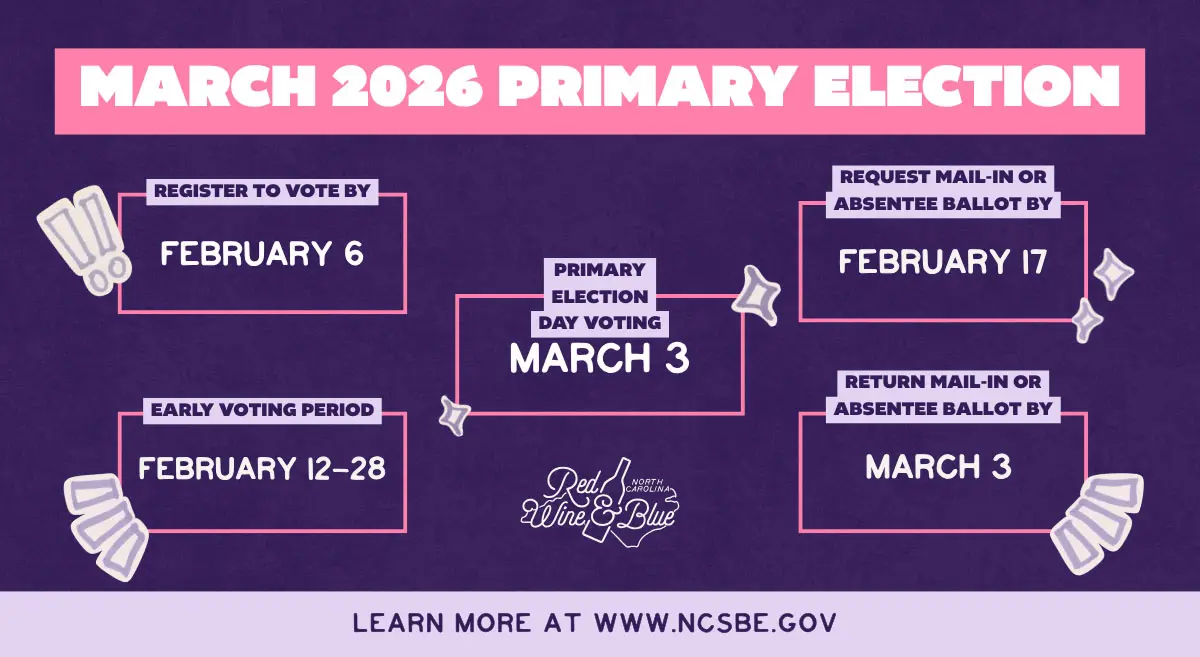
Primary Election – March 3, 2026
- Register to vote by: Friday, February 6, 2026 5:00pm
- Request a mail-in or absentee ballot by: Tuesday, February 17, 2026 5:00pm
- Return a mail-in or absentee ballot by: Tuesday, March 3, 2026 in BOE office by 7:30pm
- Early Voting: Thursday, February 12, 2026 8:00am – Saturday, February 28, 2026 3:00pm
- Primary Election Day: Tuesday, March 3, 2026 6:30am-7:30pm
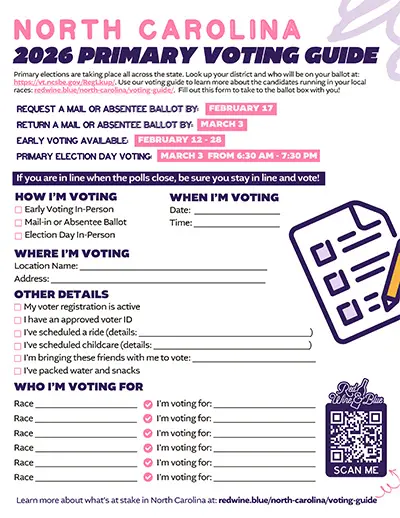
Printable Voting Guide
You can print this out, fill it in, and take it with you when you vote!
Frequently Asked Questions about Voting in North Carolina
How do I register to vote?
The deadline to register to vote in North Carolina is always 25 days before Election Day with the exception of military and overseas citizens.
How can I request an absentee ballot?
*Please note that absentee-by-mail voting is not permitted in some municipalities, so it is best to check with your county Board of Elections if you want to vote this way.
The deadline to request an absentee ballot is two weeks before Election Day, though the deadline differs for military and overseas citizen voters.
Blind or visually impaired voters can request an accessible absentee ballot online with the NC State Board of Elections.
How does early voting work?
Find your early voting sites on the NC Board of Elections website or through your county Board of Elections.
How do I vote on election day?
Polling places are open from 6:30am to 7:30pm. If you are in line to vote by 7:30pm, stay in line! Anyone in line by 7:30pm is able to vote.
Do I need an ID to vote?
A driver’s license is the most common form of ID, but there are other acceptable forms of ID. Please visit the NC Board of Elections for a complete list.
All registered voters can get a free, approved voter photo ID from their county board of elections. Find out how to do that here.
Also, all North Carolina residents can get a free, non-driver’s ID card from the North Carolina DMV. Find out how to get a “No-Fee ID Card” at the DMV here.
If you cannot show an acceptable ID in person, or can’t include a copy of your ID when voting by mail, you can still vote by filling out an ID exception form and voting with a provisional ballot. There are also some exceptions for military and overseas voters. Learn more here.
How do I know exactly what’s on my ballot?
Before every election, you can find a sample of your ballot here on the NC Board of Elections website.
How do I know my ballot was accepted?
Who’s on the Ballot?
We need to support common sense candidates who reflect our values — in every race up and down our ballot. That means filling out your full ballot and making sure to vote for school board and judicial candidates too!
You can find information below about candidates in key local races across the state. You can find your jurisdiction, polling place, and a sample ballot with additional candidates on your ballot here: vt.ncsbe.gov/RegLkup
Candidates with a green check mark next to their name have proven that they will fight for Red Wine & Blue’s values, like support for reproductive freedom, public education, and democracy.
Note: Not all North Carolina races are included in this list. Red Wine & Blue is working on the ground in these key races where we have identified candidates who will fight back against extremism in Raleigh and DC. If you’d like to see a sample of your ballot, you can look that up here on the NC Board of Elections website.
National Candidates
US Senate
Roy Cooper (D)
US Congressional District 3
US Congressional District 10
US Congressional District 11
US Congressional District 14
NC House Candidates
House District 9
House District 23
House District 27
House District 32
Pamela M. Ayscue (R)
House District 35
House District 43
House District 59
House District 60
House District 67
House District 81
House District 89
House District 99
House District 105
House District 106
House District 117
NC Senate Candidates
Senate District 12
Senate District 37
Regional Judicial Races
NC District Court - District 16 Seat 05
Christy A. Hamilton Malott (D)
NC Superior Court - District 16B Seat 02
Myra Griffin (D)
NC District Court - District 26 Seat 18
Cecilia Oseguera (D)
NC Superior Court - District 26C Seat 01
Caleb Newman (D)
NC District Court - District 31 Seat 04
Cheryl Andrews McDonald (D)
NC District Court - District 32 Seat 06
Jessie Conley (R)
NC District Court - District 37 Seat 04
Jodi M. Allred (R)
Local Races
County Commissioners
Chatham County Board of County Commissioners
Cumberland County Board of County Commissioners
Charles Evans (D)
Mario BE Benavente (D)
Forsyth County Board of County Commissioners
Mecklenburg County Board of County Commissioners
Monifa (Mo) Drayton (D)
New Hanover County Board of County Commissioners
Judy Justice (D)
Wake County Board of County Commissioners
Christine Kushner (D)
Sheriffs
Mecklenburg County Sheriff
Pitt County Sheriff
Pasquotank County Sheriff
School Boards
Durham County Board of Education
Natalie Bent Kitaif
Nadeen Bir
Gabby Rivero
Xavier Cason
Forsyth County Board of Education
Linda Winikoff (D)
Ronda Mays (D)
Steve Folmar (D)
Curtis Fentress (D)
Susan Conway (D)
Lee Childress (D)
Guilford County Board of Education
Khem D. Irby (D)
Irish Spencer (D)
Iredell County-Statesville Schools Board of Education
Cindy Haynes (R)
Boen Nutting (R)
Moore County Board of Education
Megan Numbers
Anthony B. McCauley
New Hanover County Board of Education
Orange County Schools Board of Education
Sarah Smylie
Saru D. Salvi
Lori Russell
Anne Purcell
Rockingham County Board of Education
Synthya Penaloza (R)
Union County Board of Education
Can we count on you?
Share this voting guide with friends today!
Americans trust their friends and family more than any other source for accurate information about the elections. That means your friends and family need to hear from YOU about what’s at stake in the primaries and why it’s important to vote.