
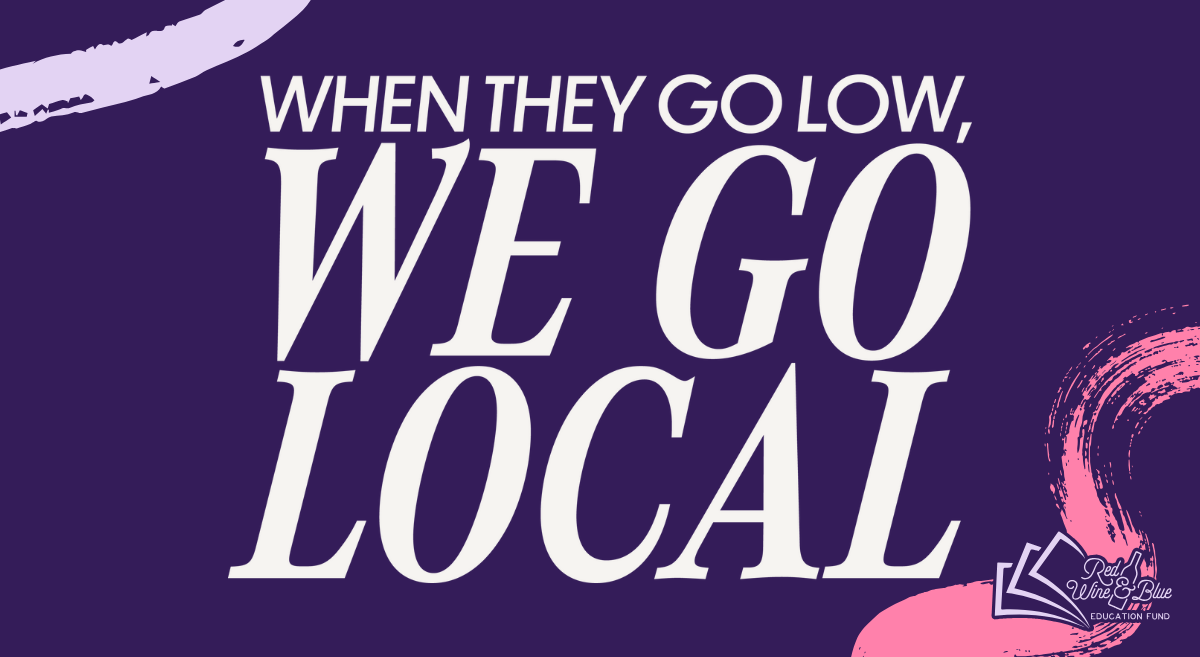
Lately, you may have seen Red Wine & Blue say, “When they go low, we go local!” What do we mean by that?
Almost a decade ago, Michelle Obama made famous the phrase, “When they go low, we go high.” This was the Obama family motto for responding to cruel, hateful bullies. Inspired by that, we’ve created our own motto for how we’re responding to the current threats coming from the federal government – when they go low, we go local.
In the face of these threats to public education, vulnerable communities, diversity and inclusion, the environment, our freedom of speech, and so much more, we know that the most effective way to respond and to protect the things we care about is to get involved locally.
Here are five reasons why going local is the best way to fight back.
- It’s the most effective way to protect your most vulnerable friends, family, and neighbors against federal threats. The most immediate protections for vulnerable communities come from local government. Let’s say you want to protect your immigrant neighbors. Sure, you can call your U.S. Congressperson, but it’s even more effective to work with your local schools and city government to make sure they have policies in place to protect families against unlawful ICE raids in schools and courthouses. Similarly, if you want to protect transgender kids in your community, you can work to make sure your local schools have policies in place that respect and protect them, and that local medical facilities continue to provide them with the healthcare they need.
- All your power is local. Research shows that public opinion doesn’t sway U.S. Congress nearly as much as it sways local school boards, city councils, municipal offices, and state legislatures. Take, for example, a small group of 10-15 people with strong voices. They may not influence a U.S. representative, but they can make a big impression and influence their town councilperson.
- It’s an opportunity rich environment. There are more than 58,000 local seats up for election between now and the end of the year. Even if you don’t normally care for politics, if you care about schools, libraries, roads, and local development, you should care about these races! Plus, this is our chance to stop extremists from getting local power and political experience that they would use to keep getting elected to higher and higher offices with even more power.
- It builds year-round local infrastructure. Extremists have been successfully organizing and building ground locally for over four decades. They’ve used churches, social clubs, and grassroots organizations to build benches of local politicians and gain the power that they have today. We need to do the same, by organizing our communities and building our own bench of commonsense politicians who work for all of us.
- It reduces polarization. Focusing on local issues has been proven to reduce polarization in communities. It’s easy to find common ground when you’re literally talking about the ground and shared spaces that you have in common.
Now let’s put the spotlight back on reason #3 for a second. Some states have primary elections this month, and most states have general elections in November. Voter turnout is usually pretty low in local elections, especially in years like this that follow a big presidential election. A lot of us took last year’s loss pretty hard, but now is not the time to step back.
Since turnout in local elections is so low, very small numbers can swing the outcomes, so every single vote counts. And after the year that we’ve had so far, wouldn’t it feel good to get some wins this November? Over the next few weeks, we’re going to talk about the many ways you can go local to help make that happen!