
You may be familiar with the movie, “Hidden Figures,” based on Margot Lee Shetterly’s book of the same name. It told the true story of Black women mathematicians for NASA who were critical to the success of the U.S. space program, but who had been overlooked by history books.
Shetterly brought the names of Christine Darden, Barbara Holley, Mary Jackson, Katherine Johnson, Kathryn Peddrew, Eunice Smith, Sue Wilder, and Dorothy Vaughan to popular culture, teaching many of us Black history that we never learned in school. But countless other figures have been hidden or overshadowed in history, so let’s shine a light on a few more!
Dr. Gladys West
Dr. Gladys West was also a mathematician. She was one of only four Black professionals working at the Naval Surface Warfare Center Dahlgren Division in Virginia when she was hired in 1956. Dr. West conducted research on satellite orbits and modeling the surface of the Earth. The mathematical model she created paved the way for Global Positioning System (GPS) technology.
While her career with the U.S. Navy spanned 42 years and her contributions to the creation of GPS are widely agreed upon, Dr. West didn’t receive public recognition until after “Hidden Figures” was released in 2016. In 2018, the military honored her as a Space Pioneer, and the Virginia General Assembly passed a joint resolution commending her work. In 2021 she was the first woman to receive the Prince Philip Medal from Britain’s Royal Academy of Engineering. In 2023 she was honored by the U.S. Navy with the first Freedom of the Seas Exploration and Innovation Award.
Dr. West died on January 17, 2026 at 95 years old. You can think of her with gratitude the next time you plug an address into your GPS!
Claudette Colvin
In January, we also lost an often overshadowed figure of the civil rights movement. Claudette Colvin passed away at the age of 86. While most of us learned in school about Rosa Parks’ bravery, Claudette Colvin was arrested for displaying the same bravery in March 1955, nine months before Rosa Parks.
Fifteen year-old Claudette was riding home from school on a segregated bus in Montgomery, AL. While she was seated in the back of the bus, it filled and the driver ordered Black passengers to give up their seats for white riders. Claudette refused and was arrested. Months later in October, Mary Louise Smith was arrested for the same thing, followed by Rosa Parks in December. Rosa Parks’ arrest sparked the Montgomery Bus Boycott, so her name earned a rightful place in history, but Colvin and Smith were two of the four plaintiffs in the landmark case that ended racial segregation on Montgomery’s buses.
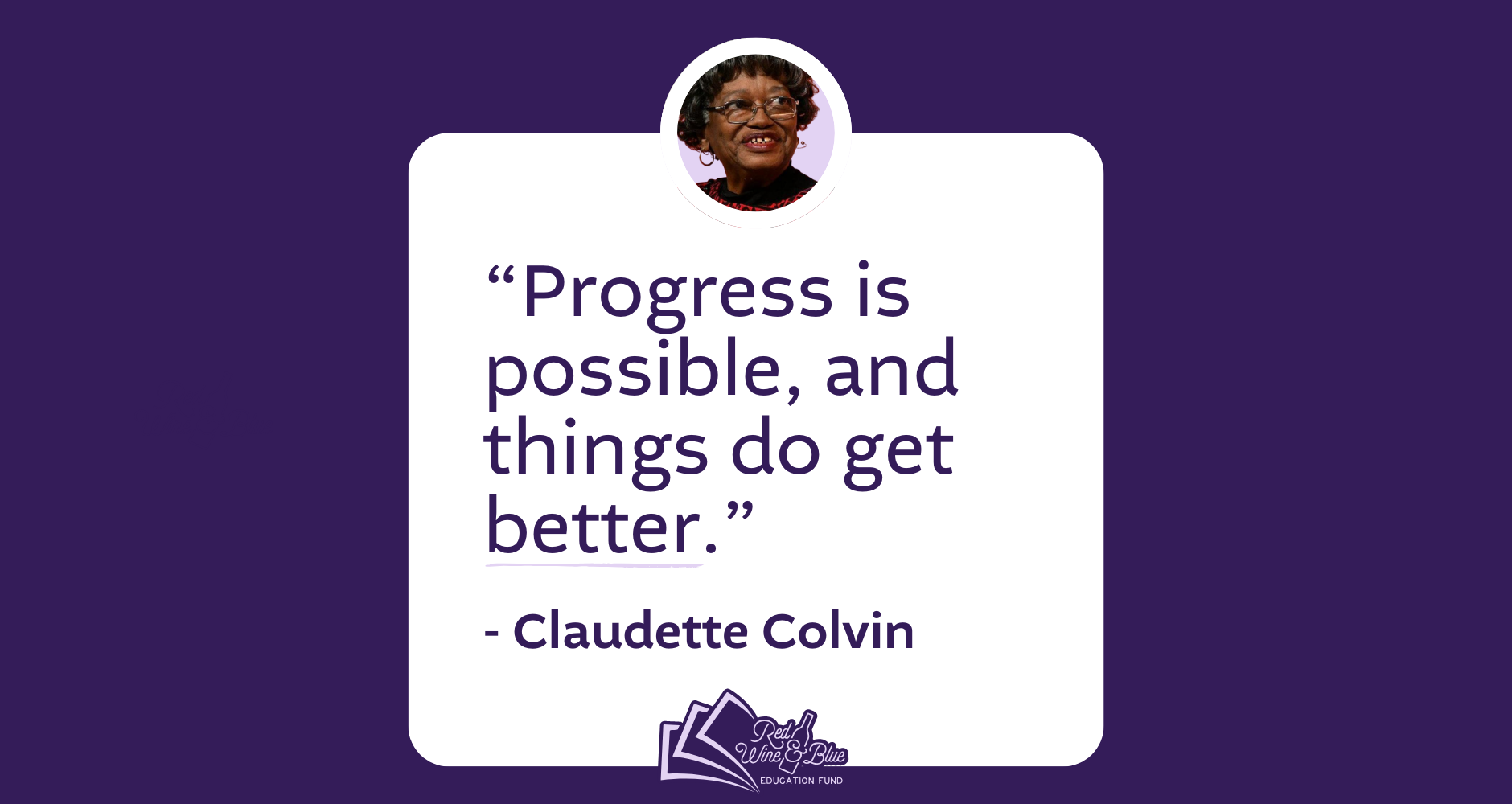
Colvin laid the groundwork for progress when she refused to give up her seat in 1955, and again in 2021 when she filed to have her record expunged, having never technically been cleared of her charges. She said it was important to show the next generation that “…progress is possible, and things do get better. It will inspire them to make the world better.”
The Bennett Belles
Many of us learned about strategic nonviolence and sit-ins as methods of protest during the Civil Rights Movement. While it was not the first, the sit-in led by the Greensboro Four at the Woolworth’s lunch counter in Greensboro, NC on February 1, 1960 gained national attention and is credited with launching a nationwide movement.
The Greensboro Four were male students from North Carolina Agricultural and Technical State University – Ezell Blair, Jr. (now Jibreel Khazan), Franklin McCain, Joseph McNeil and David Richmond, but have you ever learned about the women behind the movement? Female students like Linda Brown and Emma Washington from Bennett College played a huge role. In fact, hundreds of students known as the Bennett Belles helped plan and execute the Greensboro sit-ins.
These female students had been organizing since Martin Luther King, Jr. spoke at Bennett College in 1958. In the fall of 1959, NC A&T students joined NAACP student chapter meetings at Bennett College where the sit-ins were planned. 40% of Bennett College students participated in demonstrations between 1960 and 1963, and 250 of them were arrested during the months of the lunch counter sit-ins.
Perhaps the ultimate Bennett Belle was the college’s President, Dr. Willa Beatrice Player who first brought King to campus and who supported her students throughout the entire movement. She even brought them personal items and school assignments while they were in jail! The sit-ins eventually lead to the desegregation of the lunch counters in July 1960, and we have the Bennett Belles to thank for that!
During Black History Month, and all year long, it’s important to keep uncovering these hidden, unsung, and overshadowed heroes of the past so that we can all learn the full story of American history.