
Before the fall of Roe v. Wade in 2022, many of us thought our right to abortion was something that could never be taken away — but now we know better. 43 states now have abortion restrictions, 14 of them with total bans.1
We know that extremists have been targeting women’s reproductive healthcare for decades.2 And they don’t plan to stop with abortion bans. Everything related to reproduction — including abortion access, miscarriage treatment, fertility treatments like IVF, and birth control — is at risk.
At the root of this is the extreme-right’s long time goal of having “fetal personhood” legally recognized — a concept that says that life starts at fertilization. In January 2023, Republicans in the U.S. House introduced the Life at Conception Act, with 125 Republican sponsors, that says that human life begins at fertilization.3 And on February 16, 2024, a “fetal personhood” ruling was made in Alabama that has the potential to impact all of us.4
With its Chief Justice quoting the Bible in his concurring opinion, the Alabama Supreme Court ruled that frozen embryos are legally considered children. That means that all embryos, from the moment of fertilization, have legal rights, even before they are implanted in a woman’s uterus. IVF providers in Alabama have paused treatments while they figure out the legal impacts of the ruling.5
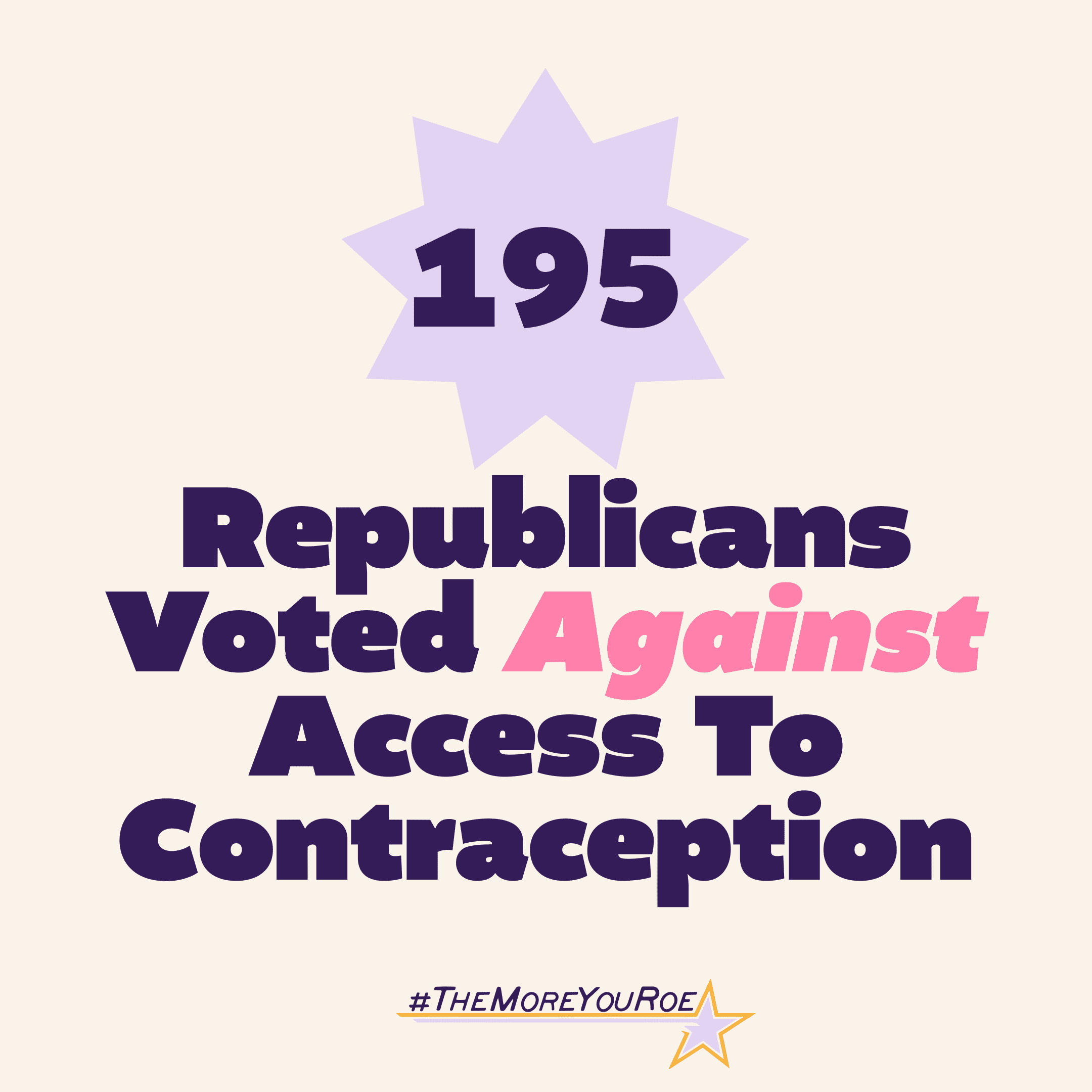 So, we’ve seen how extremists’ plans are restricting our access to abortion and IVF. What comes next? Well, shortly after the fall of Roe, 195 Republicans in the U.S. House voted against protecting the individual right to access contraception.6 Since then, several states have moved to criminalize other aspects of reproductive rights, including any birth control that stops a fertilized egg from implanting, such as intrauterine devices (IUDs). Our access to birth control, including emergency contraception like Plan B, will be at risk as long as extremists keep pursuing this idea of fetal personhood.
A lot of this doesn’t make logical sense. How is it pro-life to stop IVF procedures for the 1 in 6 women who want children but are experiencing fertility issues? And if they want to decrease the number of abortions in our country, why are they limiting access to birth control? But for them, it’s not about logic. It’s about controlling women and making our reproductive choices for us. Our access to birth control will not be safe until it is explicitly protected by law. Stay tuned for more information in the coming weeks about how we can secure that protection.