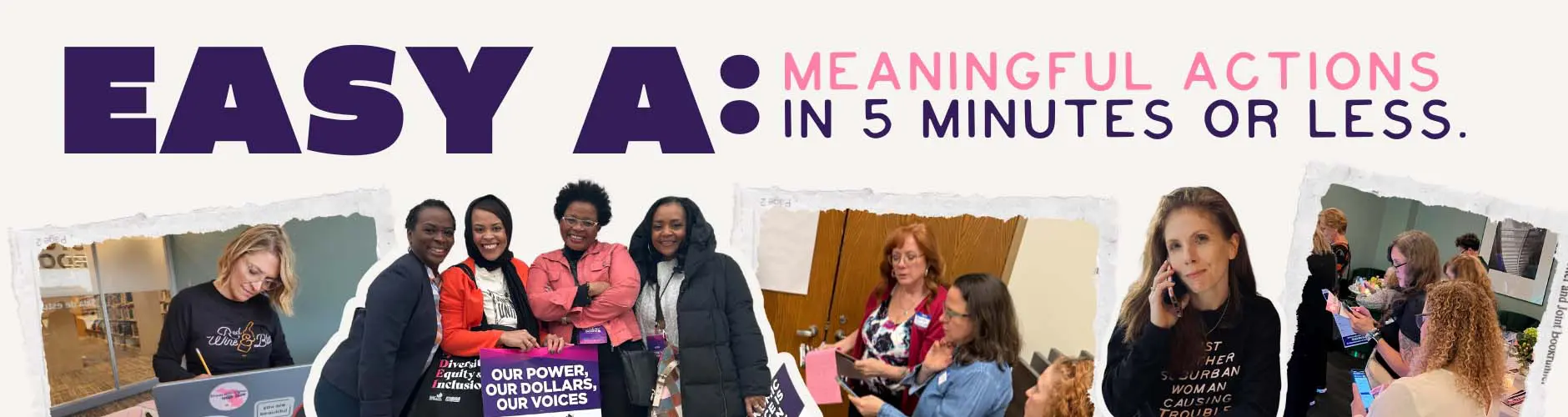
Hi there! Welcome to Easy A–Your go-to source for quick and easy actions you can take in five minutes or less about the issues you care about.
Are you a busy mom? Or maybe your work is so hectic you can’t think about anything else during the day? A lot of us are also taking care of parents or other loved ones too, leaving little time for anything else.
The good news is that these are things you can do while you’re waiting in the school pick up line, on your lunch break, or even at your kid’s soccer practice – anywhere you happen to be! And you can easily share Easy A with your friends so they can be in the know, too! We’ll send you a new action to take every week–just one, we promise –and it will always be something you can do in five minutes or less. Ready to get started? Let’s go!
Read This: Get the Flock Out of Our Communities
If you’ve ever seen the movie Minority Report, you remember the dire warning the Tom Cruise sci-fi movie gave about fighting crime using high tech surveillance. But it’s not sci-fi anymore! There’s a disturbing rise in real-life surveillance that everyone needs to know about.
WHAT IS FLOCK?
Flock is a surveillance technology company that operates a nationwide network of AI-powered, automated license plate reader (ALPR) cameras. These cameras don’t just capture license plates. They also record the make, model, and color of your car, plus unique features like scratches and bumper stickers. All of this information goes into a massive database that can be searched by law enforcement agencies to track our movement in real time.
Flock isn’t the only ALPR company, but it’s one of the largest. 100,000 of Flock’s cameras have been installed by police departments, private businesses, and HOAs in more than 6,000 U.S. cities and towns.
WHY SHOULD WE BE WORRIED ABOUT FLOCK?
Flock has been around since 2017, but ALPRs are getting more public attention now because of how the cameras are being used. Flock has repeatedly misrepresented its data-sharing practices, particularly underplaying how their data gets shared with ICE and Border Patrol and revealing a pattern of dishonesty and abuse of data.
Flock’s business model is based on creating their nationwide database of our personal information and sharing it with their entire network of clients. When local officials sign on to Flock contracts, they may think that they control their town’s information, but the standard Flock contract says Flock has the right to share our data with any government body or third party.
That’s exactly what is happening now.
- Local police departments are sharing Flock data with ICE, who are using it to search for immigrants and target activists like No Kings protestors.
- Authorities in Texas used the nationwide Flock network to track down a woman who had an abortion, bringing to reality a fear long-held by reproductive rights advocates that surveillance technology could be used against women traveling for or receiving abortion care.
- Police officers have been repeatedly caught using Flock cameras to stalk ex-girlfriends and ex-partners.
And the use of Flock data isn’t just limited to alleged crimes. Flock is also using Artificial Intelligence (AI) to look for potential criminal activity, meaning they are analyzing our movements for patterns it simply finds “suspicious” and deciding who to report to law enforcement. (Remember Minority Report? Life imitates art!)
Privacy and freedom-of-movement arguments aside, we know that AI algorithms can be biased or trained in a way that will end up targeting low-income neighborhoods and communities of color.
We all want to live in safe communities, but there is little evidence that Flock cameras, or any ALPRs, reduce crime or keep us safer. Worse, our tax dollars are supporting these Flock contracts, and nothing is safeguarding our privacy from this dangerous surveillance technology.
The good news is, we can protect our data and our communities ourselves.
LOCAL COMMUNITIES ARE FIGHTING BACK
Everyday citizens in communities across the U.S. – from Austin and Denver to Evanston, Illinois, and Cambridge, Massachusetts – have said “no” to Flock by pressuring authorities to either cancel their contracts or deactivate their cameras.
- Dayton, Ohio deactivated Flock cameras after finding that outside agencies searched their system more than 7,000 times.
- Sedona, Arizona’s City Council voted unanimously to cancel their Flock contract, saying they were lied to about data sharing.
- Hillsborough, North Carolina ended their Flock contract over privacy concerns.
- Flock contracts have also been cancelled in Charlottesville, VA, Eugene, OR, Oskosh, WI, and Coralville, IA, to name a few!
HOW TO FIGHT FLOCK IN YOUR COMMUNITY
If this is a concern for you and your neighbors, you have the power to make a difference.
You can start by asking your local decision makers to cancel your city or local agency’s Flock contract. Be sure to also share your concerns during public comment portions of your local city council meetings. Not sure if Flock cameras are even being used near you? Submit a records request to find out!
Lastly, educate your friends, family, and neighbors about the dangers of Flock and encourage them to use their voices, too. There’s strength in numbers! And stay tuned for more resources and easy ways to fight Flock from Red Wine & Blue!
Do This: They Are Coming for IVF and Birth Control
As you’ve seen over the past two weeks, extremists are targeting IVF and birth control – and it’s happening all over the country. It doesn’t matter where you live, our reproductive rights are at risk at the state and federal levels.
By now you’re probably wondering, how can we stop this attack on reproductive care? That’s why we’ve launched a new campaign called, They’re Coming for IVF and Birth Control…We’re Coming for their Jobs, and we want you to join us!
Join our campaign to say “hell no” to extremists who want to take away our rights to IVF and birth control.

Through this campaign, we’ll keep you informed about what’s going on with these issues, and give you simple actions to take throughout the year. The first one is easy – just sign up!
Watch This: They are coming for IVF and Birth Control
Last week we learned about how extremists are now targeting more of our reproductive rights. This isn’t just happening in red states — this trend is affecting every single one of us, no matter where we live. And even though some may try to deny it, Republican representatives at the state and federal level are talking more openly about taking away our rights to IVF and birth control. We have the receipts — their statements AND their voting records.
It might sound hyperbolic — we know it’s hard to imagine this could happen in the United States — but we’ve seen it happen before. Just watch this video and listen to the way Supreme Court Justices promised Roe v. Wade was settled law, then overturned it. Now extremist legislators see a path to continue to strip away all our reproductive choices.
Extremists are coming for our rights. Stay tuned to learn how you can help us come for their jobs.
Read This: They Are Coming For Our Contraception
Before the fall of Roe v. Wade in 2022, many of us thought our right to abortion was something that could never be taken away — but now we know better. 43 states now have abortion restrictions, 14 of them with total bans.1
We know that extremists have been targeting women’s reproductive healthcare for decades.2 And they don’t plan to stop with abortion bans. Everything related to reproduction — including abortion access, miscarriage treatment, fertility treatments like IVF, and birth control — is at risk.
At the root of this is the extreme-right’s long time goal of having “fetal personhood” legally recognized — a concept that says that life starts at fertilization. In January 2023, Republicans in the U.S. House introduced the Life at Conception Act, with 125 Republican sponsors, that says that human life begins at fertilization.3 And on February 16, 2024, a “fetal personhood” ruling was made in Alabama that has the potential to impact all of us.4
With its Chief Justice quoting the Bible in his concurring opinion, the Alabama Supreme Court ruled that frozen embryos are legally considered children. That means that all embryos, from the moment of fertilization, have legal rights, even before they are implanted in a woman’s uterus. IVF providers in Alabama have paused treatments while they figure out the legal impacts of the ruling.5
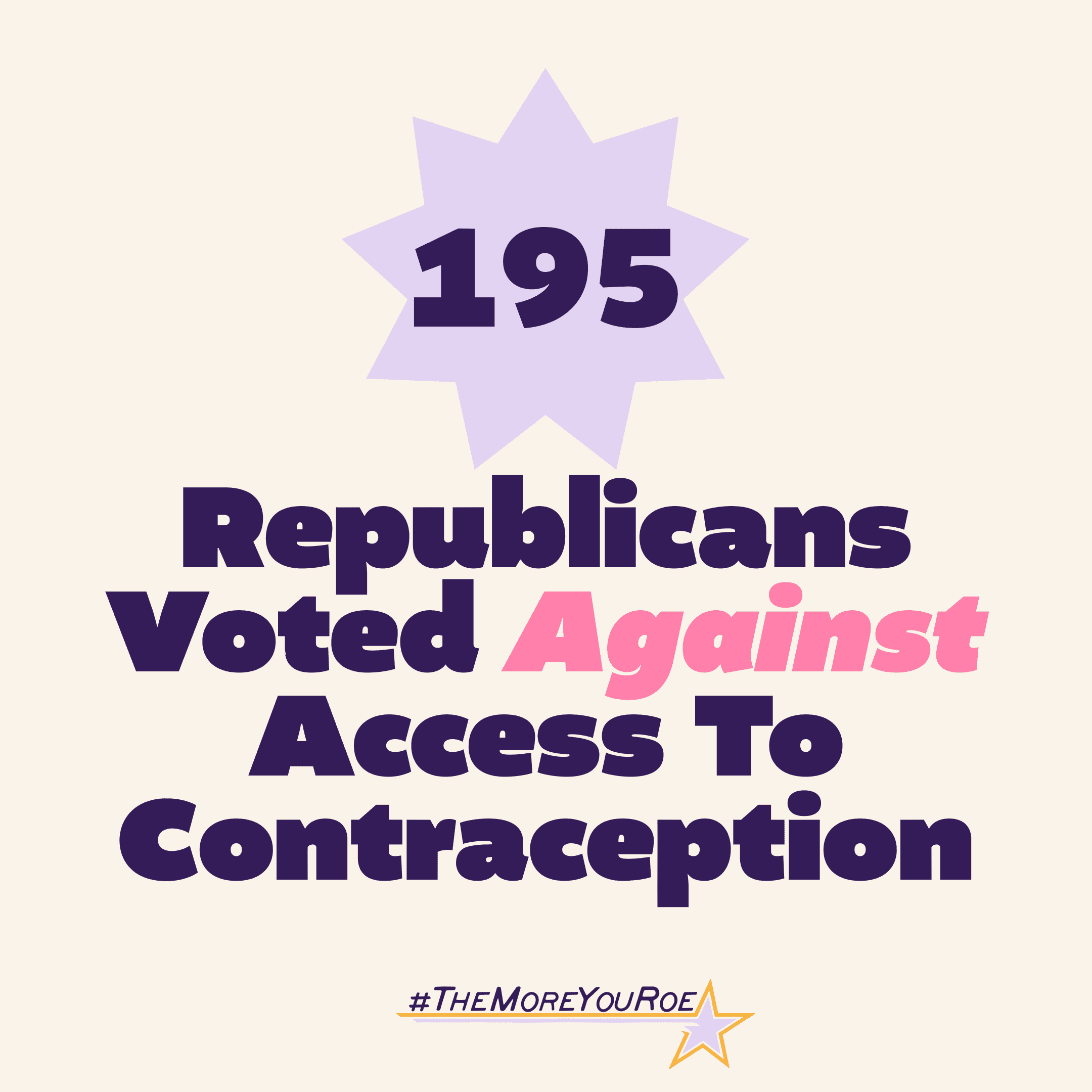 So, we’ve seen how extremists’ plans are restricting our access to abortion and IVF. What comes next? Well, shortly after the fall of Roe, 195 Republicans in the U.S. House voted against protecting the individual right to access contraception.6 Since then, several states have moved to criminalize other aspects of reproductive rights, including any birth control that stops a fertilized egg from implanting, such as intrauterine devices (IUDs). Our access to birth control, including emergency contraception like Plan B, will be at risk as long as extremists keep pursuing this idea of fetal personhood.
A lot of this doesn’t make logical sense. How is it pro-life to stop IVF procedures for the 1 in 6 women who want children but are experiencing fertility issues? And if they want to decrease the number of abortions in our country, why are they limiting access to birth control? But for them, it’s not about logic. It’s about controlling women and making our reproductive choices for us. Our access to birth control will not be safe until it is explicitly protected by law. Stay tuned for more information in the coming weeks about how we can secure that protection.
Do This: Tell Your Friends About The Maternal Mortality Crisis
Now you’ve read about how maternal mortality rates in the U.S. are drastically increasing, and how that means more women are dying. You also heard from Georgia Representative Jasmine Clark about how access to preventative healthcare can help women have healthier pregnancies and reduce our maternal mortality rates. Doctors and medical experts have solutions to this crisis, so we can’t let these tragic deaths continue to happen.

So what can we do about it? Raise our voices! Share this information with your friends and family, and let’s demand better reproductive healthcare access for ALL women! We’ve made it super-easy with our social media share tool. Start below, and with just a few clicks, you can share this information and earn your Easy A today!
Watch This: Maternal Mortality Rates in the U.S.
Last week we learned about the horrifically-high maternal mortality rate in the U.S., and how women of color are most affected. Recently our own Jasmine Clark, co-host of The Suburban Women Problem podcast and a Georgia State Representative with a PhD in Microbiology, spoke on the floor of the Georgia State House about maternal mortality rates. The Speaker of the House cut her off and denied her the full 2 minutes to speak.
We find it particularly offensive for a Black woman to be silenced when she is speaking about this crisis in maternal healthcare, and we aren’t going to be quiet about this issue.
Watch Jasmine’s speech below, and stay tuned next week for an opportunity to raise your voice about the maternal mortality crisis!
Read This: Maternal Mortality Rates in the U.S.
Did you know that the U.S. is the only developed country in the world with a high maternal mortality rate? “Maternal mortality” refers to when women die during pregnancy, childbirth, or shortly after the end of their pregnancy due to complications. In 2021, we were ranked 55th in the world for maternal mortality, despite having an advanced healthcare system. Other developed nations rank much higher, like the Netherlands, Spain, Germany and Australia, and most of Europe.
If that’s not bad enough, our maternal mortality rate has actually been increasing in recent years! We are moving in the wrong direction and more women are dying.

In 2021 the maternal mortality rate in the U.S. was 32.9 deaths per 100,000 live births. To put that into perspective, 1,205 women died from maternal causes. That’s a 40% increase in just one year! Those women were our sisters, our daughters, our partners, and our friends.
And women of color are much more likely to die from pregnancy or childbirth than white women. In 2021, Native American women’s maternal mortality rate was 4.5 times that of white women, and Black women’s rate was 2.6 times the rate of white women.
Although not all states track maternal mortality rates, we do know that certain regions, like the south, have higher maternal mortality. And states with stricter abortion laws often have the highest maternal mortality rates. With abortion restrictions increasing throughout the United States, and the resulting deserts of maternal healthcare, experts fear the maternal mortality rate will continue to increase in the U.S.
That means more women will die — people we know and love, possibly even ourselves — due to complications with pregnancy, childbirth or the immediate postpartum period, and that’s unacceptable.
The big question is, what can we do about it? You just took the first step by reading about the problem. Stay tuned for more info and how to take action. Thanks for completing your Easy A action for this week.
Take It One Step Further: Subscribe to the Suburban Women Problem on Substack

As you know, many of our weekly Easy A actions, like the latest series on the problem with school vouchers, have been informed by our awesome podcasts, The Cost of Extremism and The Suburban Women Problem. You know those “Listen to This” clips we share with you? Those come from our pods! If you’ve enjoyed learning from their in-depth coverage of important topics — even if you don’t have a chance to listen — then we have some exciting news for you!
The Suburban Women Problem is now on Substack! Each week, they’ll be sharing stories, updates, and key information about their podcast topic, and you can get those posts delivered directly to your email inbox! What a great way to do a deeper dive into topics you’re wanting to learn more about.
Check out The Suburban Women Problem on Substack here: substack.redwine.blue and subscribe to get the posts right in your inbox!
Do This: Sign the Petition to Stop School Vouchers
 Ok, now that you know more about the harm that school vouchers can do to a public school system, you’re probably wondering what you can do to help — We’ve got you.
We are committed to protecting public schools so that all children can learn and thrive, and we know you are 100% with us on that. Let’s take the next step together: sign our petition to protect public education for all kids.
Thanks for taking action this week!
Watch This: The Problem with School Vouchers
Now that you’ve read about school vouchers, let’s dig a little deeper. Watch this video with education journalist Jennifer Berkshire where she shares how school vouchers are not a new idea. These programs have been around for awhile, but get renamed and rebranded by those who advocate for them because they know they are unpopular. Voters have historically rejected vouchers because they don’t want taxpayer dollars going to private religious schools, and because they see how school choice programs don’t benefit most students. We support public education as an institution that benefits all of us.
To hear more of our discussion about school vouchers, check out the full podcast here, or stream anywhere you get your podcasts.
Read This: The Problem with School Vouchers
 School vouchers sound fairly innocent, don’t they? But did you know that school vouchers take taxpayer funds away from public schools and direct it to religious and private institutions that are not held to the same standards of education, equity and opportunity?
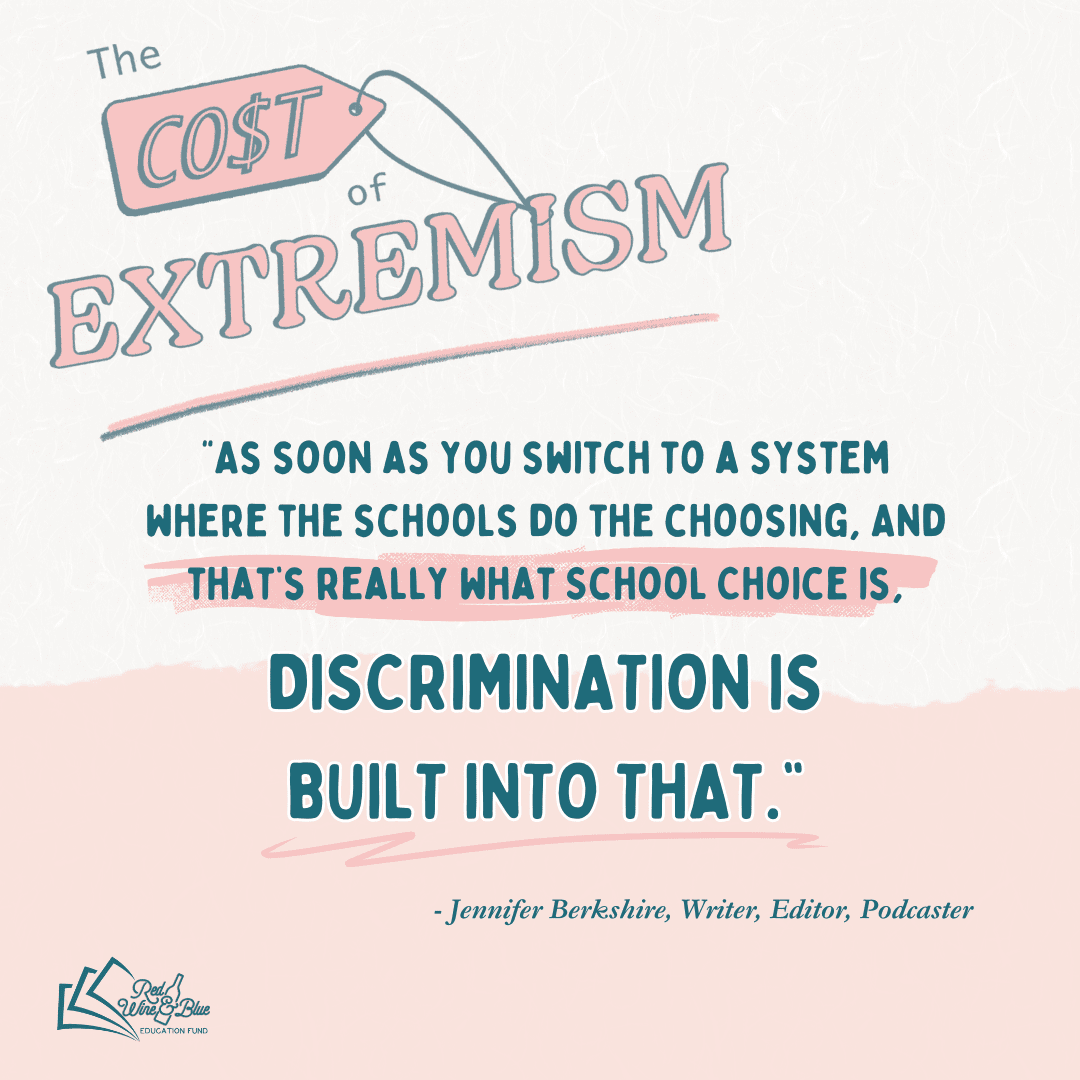
Proponents of school vouchers like to call this “school choice” — implying that vouchers are giving parents more options in their children’s education. But in reality, the actual choice is with the schools. Private institutions — even if they’re receiving public funds through voucher programs — are not required to admit students and can deny entrance to anyone. This means students with learning disabilities, students of color and students from lower socio-economic backgrounds often get left behind. All while these funds are diverted from public schools, making it harder for them to serve everyone.
So if school vouchers don’t give all students more choice in education, what’s the point? The real reason behind school voucher programs is to defund public education. It’s one step in a plan to eventually privatize education in the United States. We can’t let that happen. All students deserve access to well-funded public schools that provide equitable opportunities to learn and succeed.